— About G8 Sports —

Before G8 Sports...

— 1977 —

In 1977, a teenage athlete in the Philippines was serving as Assistant Coordinator of a national youth athletic organization.

The Armed Forces of the Philippines awarded him a Plaque of Merit for "promoting sportsmanship across the country" and contributing to the national youth development program. He was eighteen years old.
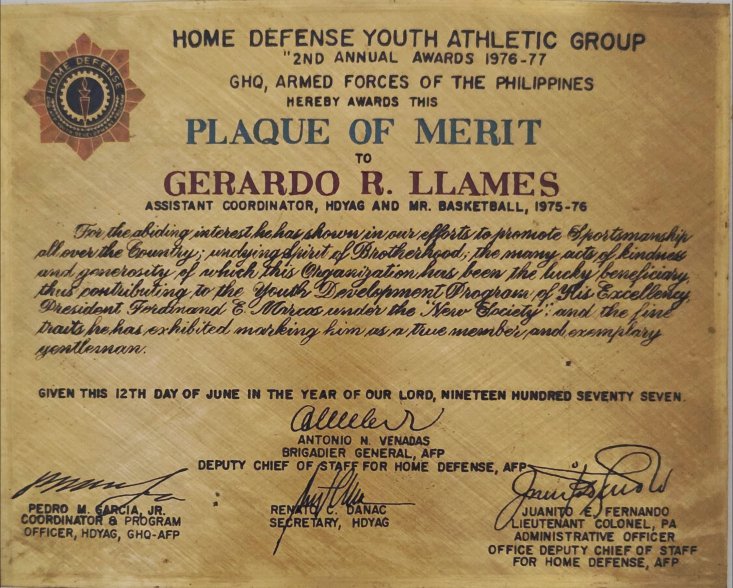
Plaque of Merit awarded by the Armed Forces of the Philippines, 1977
Plaque of Merit, Armed Forces of the Philippines — 1977
— Then —

there was a Mechanical Engineer who studied Value Engineering. The same mind that learned to engineer efficiency into systems was already applying those principles to athlete development.

Value Engineering — the discipline of optimizing function and eliminating waste — became part of how he saw the work.

— Then —

there was a coach in Northern Virginia who watched the youth sports system change.

Sessions got longer. Groups got larger. Specialization started earlier. Injuries climbed. The values once recognized in writing — sportsmanship, brotherhood, contribution — gave way to rankings, reels, and recruiting metrics. He kept coaching the way he always had. Quietly. With the discipline of the system that taught him.

Now

There is G8 Sports.

The current chapter of a long, continuous practice.

— The G8 Method —

Not a workout.
A development system.

The G8 Method is built on three priorities: the well-being of the whole athlete, the integrity of human movement, and the reduction of injury risk. Every choice — session length, group size, exercise selection, recovery — comes back to these three.

— 01 —

Well-Being

The athlete is a whole person. Physical health, mental engagement, social cohesion, and a sense of belonging to the work.

— 02 —

Movement

The body is engineered to run, jump, and change direction. Mastery of fundamental movement comes before sport-specific skill.

— 03 —

Injury Reduction

Built into every session. Short, focused, never to fatigue. When injuries do happen, the methodology applies to recovery.

Built around
the athlete,
not the sport.

An athlete is a whole person. A young athlete more than most. Their physical development, their mental engagement, their social life, their sense of self — these aren't separate concerns from training. They are the training.

Sessions cap at fifteen athletes. Always. When demand grows, we add sessions and coaches — never more bodies on the field. Every athlete gets eyes on every rep. They aren't lost in a crowd of fifty kids running drills.

Sessions cap at sixty minutes. Always. Athletes leave wanting more, not wanting out. The thing they remember from the day is the work and the laughter — not the exhaustion.

The training is rigorous. The atmosphere is human. There's room for humor, but also a coach who knows when to push and when to let up.

We don't train athletes to be stars. We train them to be athletes. The stars are a byproduct.

And if cost is an obstacle for a family that wants their child in the program — call anyway. Quiet help, when it's needed, is part of how this program has always worked.

Movement
before sport.

The human body is engineered to run, jump, and change direction. Children figure this out on their own — climbing trees, chasing each other across yards, racing without thinking about technique. Modern life dulls the instinct. Our job is to restore it.

Most kids arrive wanting sport-specific drills — the basketball ladder, the soccer cone, the football route. We start somewhere else. We start with how the body is supposed to move.

  • Speed mechanics.
  • Agility.
  • Flexibility through dynamic motion.
  • Endurance the athlete actually needs.
  • Strength built from the body itself, not the iron rack.

An athlete with mastery of these fundamentals improves at every sport. An athlete without them plateaus and gets hurt.

We use bungee-cord rebounders as a primary tool — a low-impact training surface that develops the elastic strength sprinters and jumpers need, without the joint wear of repeated hard-surface plyometrics. We use bodyweight work. We use medicine balls and implements when warranted. We do not use heavy weights with growing athletes. Nothing over fifteen pounds, ever.

The methodology is built on what the human body already knows how to do. The job is to remove what's getting in the way.

Why injuries
are rare.

Injuries are rare in our environment. When they happen, we focus on helping athletes move better so they can return stronger.

The current youth sports culture has produced what we call the "instant athlete" — a child pushed toward early specialization, year-round travel teams, and adult-style training volume before their bodies are ready for it. The result is an epidemic of overuse injuries, burnout, and athletes who peak at fourteen and quit at sixteen. Everyone in the system knows this. Few are willing to say it.

We say it. And we do something different.

Sessions stop before fatigue compromises form. Groups stay small enough that mechanics are corrected in real time. Loads stay light enough to develop strength without breaking the connective tissue of a still-growing athlete. The schedule respects the season — explosive work moves to controlled surfaces in cold weather, when muscles are tight and the risk of strain is highest.

When an athlete does come in with a strain, a tweak, or a setback from another sport, the same methodology applies in reverse. We work on the movement that broke down. We rebuild it correctly. The athlete returns stronger than they were before — not because the injury made them stronger, but because the work done after did.

A fellow coach put it this way:

Coach Gerry is like no other trainer or sports training system. He has his own unique and specialized methods that produce maximum results. The training is hard but somehow always keeps a smile on the kids' faces.

— The Coach —

The athlete is never finished.
Neither is the coach.

Coach Gerry is a Mechanical Engineer with forty-plus years of coaching experience and a background in Value Engineering. At sixty-eight, he still demonstrates every drill on the program himself.

Coaches at any level are welcome to visit a session, observe the work, and demonstrate the drills alongside us. Good coaching is built on shared knowledge.

Recognized for youth athletic development since 1977.